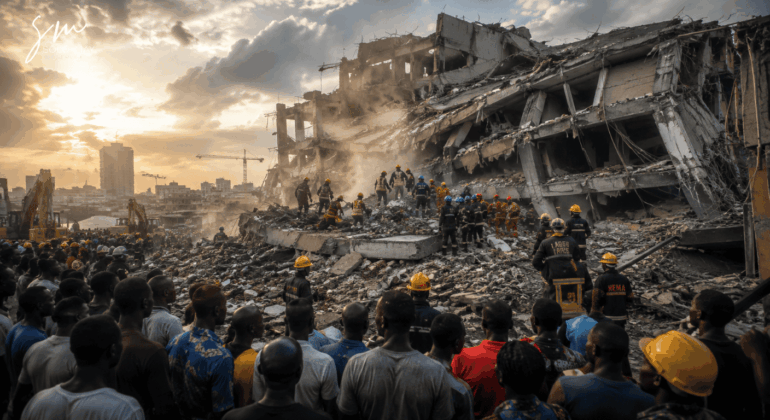

Every time a building comes down in Nigeria, the response follows a familiar pattern. Emergency responders rush to the scene, officials promise an investigation, and the news cycle moves on until the next one. But for the families who lose loved ones under the rubble, the grief is permanent.
Nigeria has recorded 679 building collapse incidents between 1971 and 2025, claiming at least 1,639 lives, according to the Building Collapse Prevention Guild (BCPG). That is not an accident of nature. It is a crisis rooted in choices and one of the most consequential choices being skipped is the geotechnical survey. Building Collapse Prevention Guild / Radarr Africa, October 2025
The Real Cause Nobody Talks About Enough
Conversations about building collapse in Nigeria almost always land on the same list: substandard materials, quack contractors, bribery, and poor regulatory enforcement. These are real problems. But there is a quieter cause sitting underneath all of them literally.
Research published by the Nigeria Building and Road Research Institute (NBRRI) found that geotechnical investigation failures are the second-leading cause of building collapse in Nigeria, accounting for 21.54% of recorded cases behind only substandard materials. What this means, in plain terms, is that one in every five collapsed buildings in this country failed partly because nobody properly studied the ground before construction began.
Soil is not uniform. It shifts, expands, compresses, and absorbs water differently from one plot to the next even on the same street. A developer who builds on a neighbour’s successfully standing structure and assumes the soil is the same is taking a gamble with other people’s lives. NBRRI / Science Publishing Group, 2026 | Guardian Nigeria, March 2026
What a Geotechnical Survey Actually Does
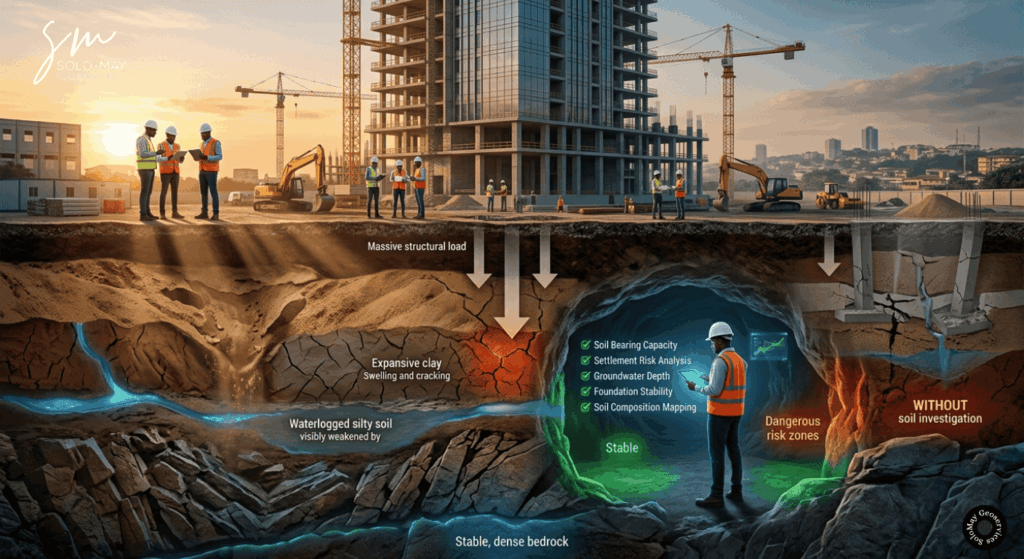
A geotechnical survey — also called a soil investigation or site investigation is a scientific assessment of the ground conditions at a construction site before any foundation is designed or dug. It tells engineers the critical facts that no amount of guessing can replace:
- Soil bearing capacity — can this ground actually support the weight of what you’re building?
- Soil type and composition — is it sandy, clayey, expansive, or waterlogged below the surface?
- Depth to bedrock or stable layers — how deep does the foundation need to go?
- Groundwater presence — is there water beneath the site that could weaken or shift the foundation over time?
- Settlement risk — will the ground compress unevenly under load, causing the structure to tilt or crack?
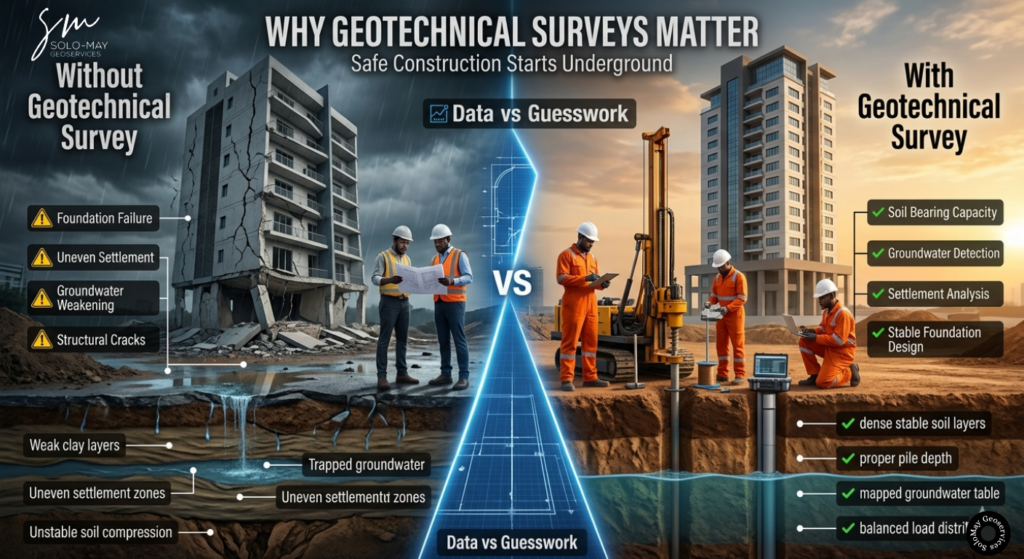
Without this data, a structural engineer is essentially designing a foundation in the dark. The result is often a building that performs well for a few years until the dry season exposes a shrinkable clay layer, or the rains raise the water table and soften a silty subsoil that was never meant to carry that load. Nigeria Housing Market / Construction Experts, March 2026
Why Skipping Soil Testing Is Dangerous
The most common reason developers give for bypassing soil investigation is cost. A geotechnical survey is seen as an additional expense in a construction budget already stretched by the price of materials and labour. But this thinking inverts the actual math.
Sulaimon Yusuf, President of the Building Collapse Prevention Guild, has been explicit about the consequence: many privately-built residential properties skip soil testing entirely because developers treat it as optional rather than essential. He has called for a “No Soil Report, No Development Permit” policy to be enforced across all states.
The economic cost of a collapsed building — debris removal, investigation, potential lawsuits, loss of the site, displacement of occupants, and reputational damage to the developer — runs into hundreds of millions of naira. A geotechnical survey costs a fraction of that. It is not an expense; it is insurance. Housing TV Africa, March 2026
Safe Construction Starts Underground
The most robust structure in the world cannot compensate for a poorly investigated foundation. This is the fundamental truth that geotechnical engineers have always known and that Nigeria’s building collapse record is now proving at enormous human cost.
A proper geotechnical survey does not guarantee a building will never face problems. But it dramatically reduces the likelihood of foundation failure by ensuring that every design decision, depth, type, width, reinforcement is grounded in real data about the specific plot of land. That is not a luxury for large projects. It is the minimum standard for any construction that will shelter human beings.
Working With the Right Professionals
Solo-May Geoservices provides comprehensive geotechnical survey services for residential, commercial, and industrial construction projects across Nigeria. Our site investigations combine soil sampling, laboratory analysis, and detailed engineering reports that give your structural team the accurate subsurface data they need to design safely and confidently.
Whether you are a property developer, architect, civil engineer, or private landowner planning a new build, we can help you make decisions that protect both your investment and the lives of the people who will occupy your structure.
The question is not whether you can afford a geotechnical survey. The question is whether you can afford to build without one.
Contact Solo-May Geoservices to schedule a site investigation.