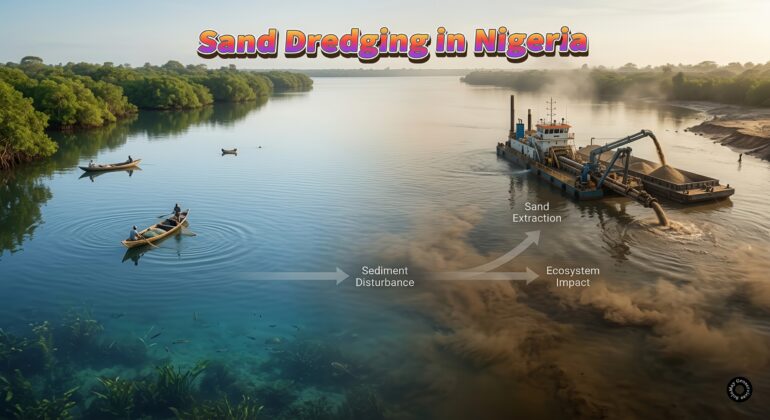
Across Nigeria, especially in coastal regions like Lagos, sand dredging has become a booming industry, driven by rapid urbanization and the demand for construction materials.
But beneath this economic activity lies a growing environmental crisis.
What appears to be a routine operation extracting sand from rivers and lagoons is quietly reshaping ecosystems, degrading water quality, and threatening the very communities that depend on these water bodies for survival THE GUARDIAN
A Real-Time Crisis: What Is Happening in Lagos
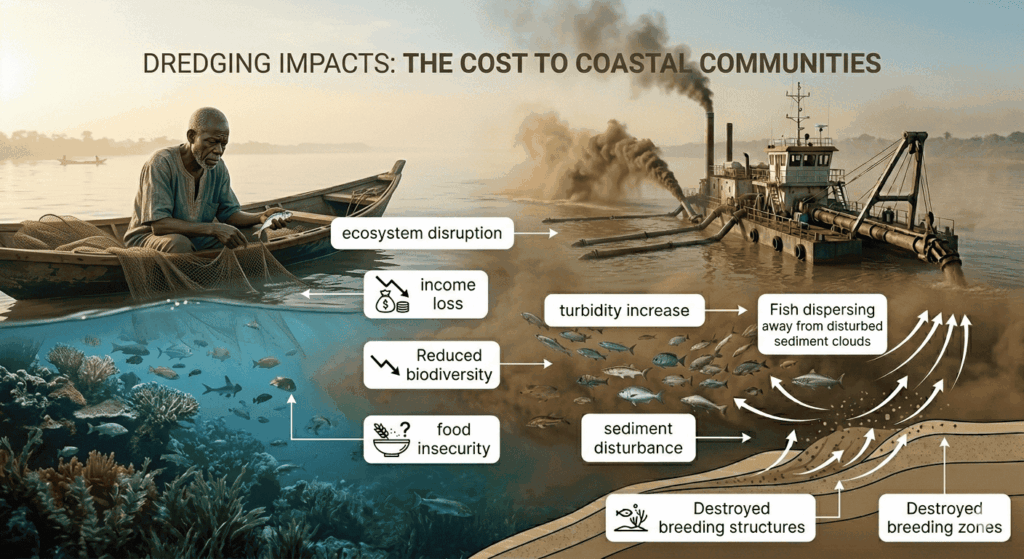
“We used to cast our nets at 7 pm and return before midday… but now, because of the dredging, we have to travel much farther… and sometimes we come back almost empty-handed.”
A local fisherman explained his experience and its effect on his family.
“The fish are disappearing… and our children still need to eat.”THE GUARDIAN
As dredging intensifies, sediment disturbance and habitat destruction are driving fish further away, making what was once a predictable source of income increasingly uncertain and exhausting. What used to sustain entire households now requires longer hours with diminishing returns. This growing reality highlights how environmental degradation is directly translating into economic hardship and food insecurity for affected communities. In 2026, investigations into activities around the Lagos Lagoon revealed alarming environmental changes linked to dredging operations.
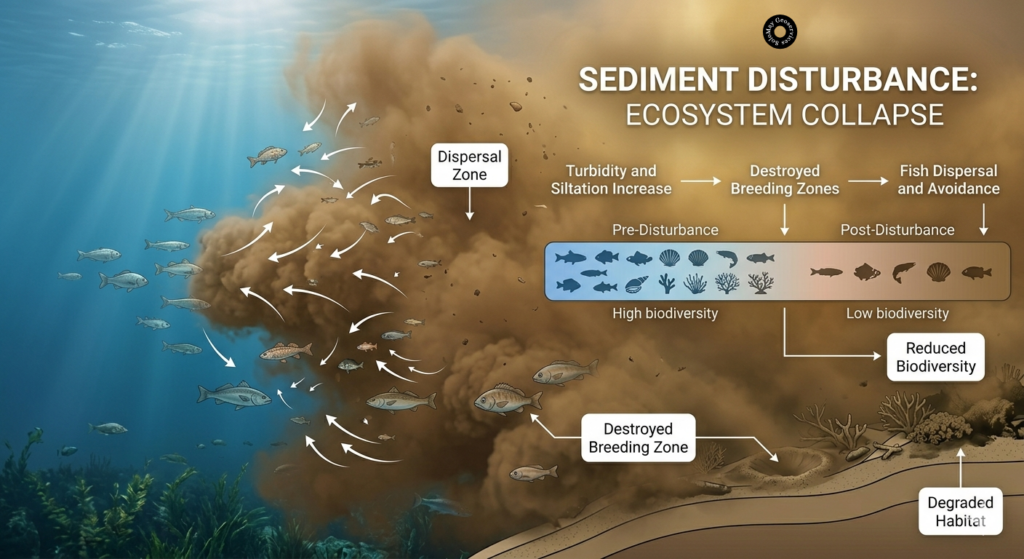
Scientists and environmental advocates warn that dredging is pushing parts of the lagoon toward ecosystem collapse
Studies show that some areas have experienced up to 6 meters of seabed loss due to continuous extraction
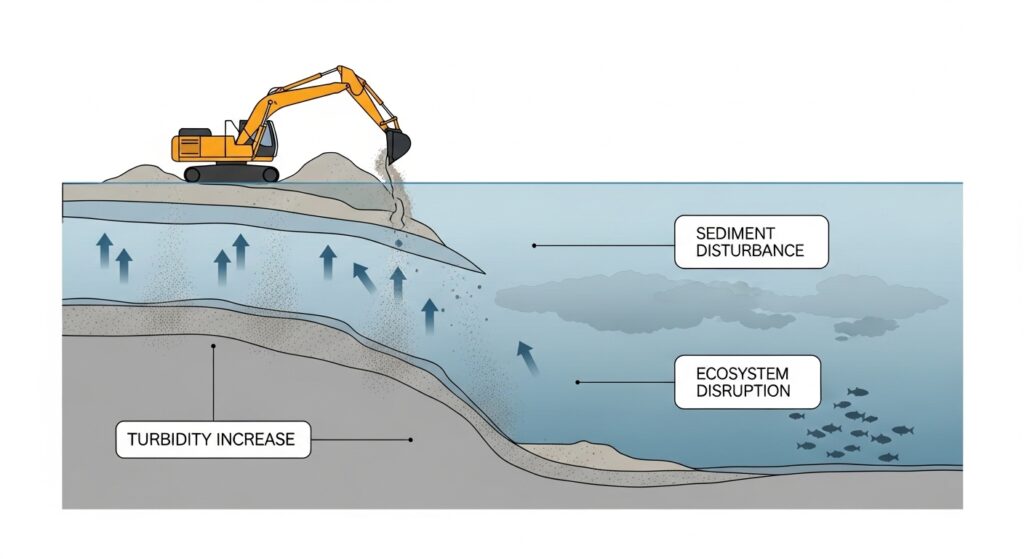
Increased turbidity is altering aquatic habitats, destroying breeding grounds for fish and other species
Local fishing communities are reporting sharp declines in fish populations and income At the same time, researchers warn that dredging is weakening the lagoon’s natural ability to absorb floodwaters, increasing long-term flood risks for Lagos and its surrounding communities This is no longer a theoretical concern; it is happening now AP NEWS
Understanding Sand Dredging and Its Environmental Impact
Sand dredging involves removing sediments from riverbeds, lagoons, or coastal areas, primarily for construction purposes.
While regulated dredging can be managed sustainably, uncontrolled and poorly monitored dredging leads to significant environmental disruption.
In simple terms, dredging changes both the physical structure and chemical balance of water bodies SCRIP
Key Environmental and Water System Risks
1. Water Quality Degradation
2. Destruction of Aquatic Ecosystems
3. Increased Flood Risk
4. Groundwater and Subsurface Instability
5. Socio-Economic Impact on Communities
Why Environmental Monitoring Is Now Critical
The issue is not just dredging—it is unmonitored dredging.
Without proper environmental oversight:
Impacts go undetected
Regulations are not enforced
Damage becomes irreversible
Experts are increasingly calling for:
Environmental Impact Assessments (EIA)
Continuous water quality monitoring
Stronger regulatory enforcement
The Role of Environmental & Geoscience Experts
Addressing this crisis requires more than policy, it requires data, science, and technical expertise.