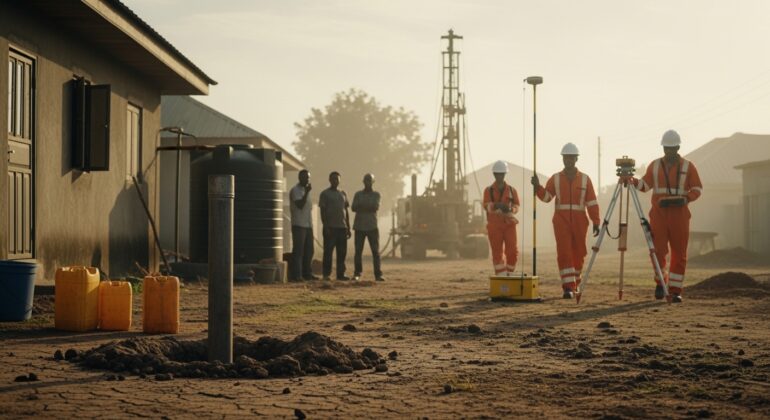

Across Nigeria, boreholes are a primary source of water for homes, hospitals, commercial facilities, and industrial operations. Yet, many boreholes fail within months of drilling, leading to wasted investment, water scarcity, and operational disruption.
For property owners and developers, borehole failure is not just a technical issue; it is a financial and environmental risk.
The reality is that many of these failures are preventable. In most cases, they result from poor subsurface understanding, inadequate site investigation, or the absence of geophysical surveys before drilling.
This is where geophysics becomes critical.
Understanding Borehole Failure
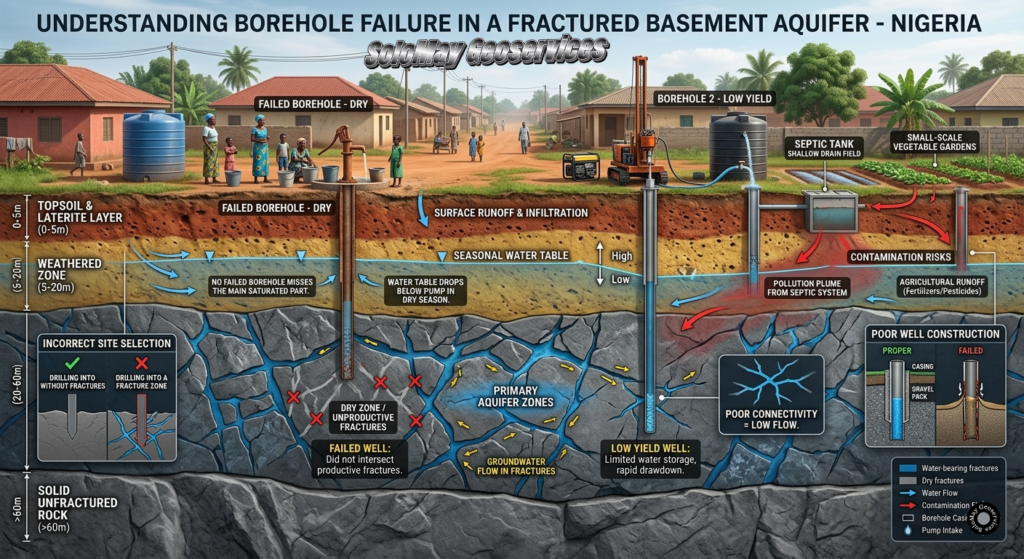
A borehole is designed to access groundwater stored within subsurface geological formations known as aquifers. However, groundwater is not evenly distributed beneath the earth’s surface. Its availability depends on:
- Geological structure
- Rock type and permeability
- Fracture zones and weathering
- Depth to water table
Without proper investigation, drilling becomes a trial-and-error process, significantly increasing the risk of failure.
Common Causes of Borehole Failure in Nigeria
1. Poor Site Selection
One of the leading causes of borehole failure is drilling in locations with low groundwater potential. In many cases, boreholes are sited based on convenience rather than scientific assessment.
In crystalline basement terrains common in southwestern Nigeria, groundwater is often found in fractured or weathered zones. Drilling outside these zones frequently results in dry or low-yield boreholes.
2. Inadequate Hydrogeological Investigation
A lack of proper subsurface investigation means critical information about aquifer depth, thickness, and productivity is unknown.
Without hydrogeological data, it becomes difficult to determine:
- Optimal drilling depth
- Expected yield
- Sustainability of the water source
3. Poor Drilling Practices
Even in areas with groundwater potential, poor drilling techniques can lead to failure. Common issues include:
- Improper casing installation
- Inadequate screen placement
- Incorrect borehole design
These mistakes can reduce water yield or lead to early borehole collapse.
4. Seasonal Variability and Over-Abstraction
Groundwater levels fluctuate between wet and dry seasons. Boreholes drilled without considering seasonal variation may perform well initially but fail during dry periods.
Over-abstraction, excessive water withdrawal, can also lead to:
- Declining water levels
- Reduced borehole yield
- Long-term aquifer depletion
5. Contamination and Water Quality Issues
In some cases, boreholes fail not because of quantity, but due to poor water quality. Contamination from:
- Septic systems
- Industrial activities
- Agricultural runoff
can render a borehole unusable WHO
The Hidden Risk: Financial and Operational Loss
A failed borehole represents more than just a dry well:
- Capital loss from drilling costs
- Additional expenses for re-drilling
- Operational disruptions for businesses and facilities
- Water insecurity for households and communities
How Geophysics Helps Prevent Borehole Failure
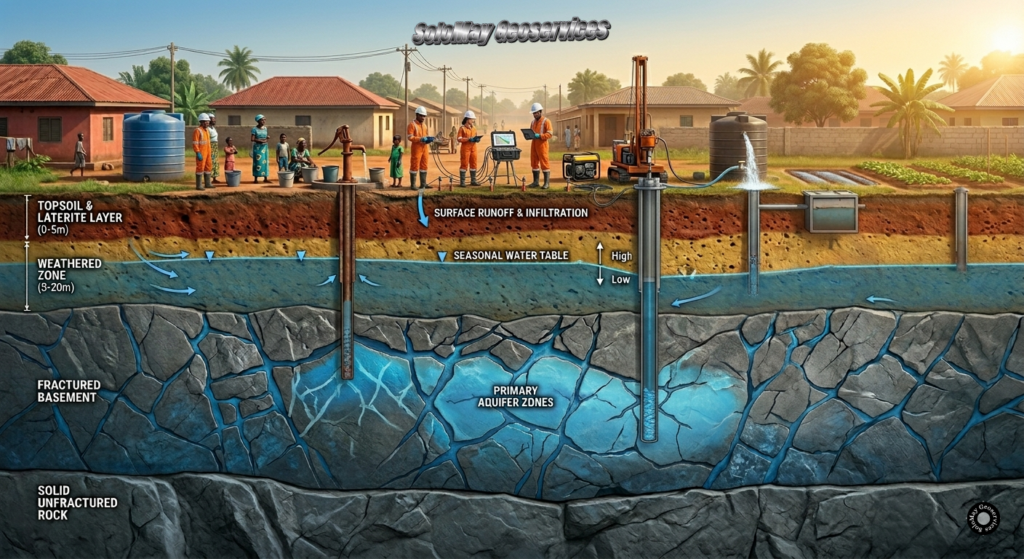
Instead of relying on guesswork, geophysical surveys use physical principles to map underground structures and identify groundwater-bearing zones.
1. Electrical Resistivity Survey
The most widely used method for groundwater exploration in Nigeria is the electrical resistivity method.
This technique measures how strongly subsurface materials resist electrical current. Different materials, such as clay, sand, and fractured rock, have distinct resistivity values.
Key benefits:
- Identifies aquifer zones
- Determines depth to groundwater
- Maps fractures and weathered layers
- Reduces drilling uncertainty
2. Accurate Borehole Siting
Geophysical data allows experts to pinpoint the most promising drilling locations.
Instead of random placement, boreholes are sited based on:
- Aquifer presence
- Thickness of water-bearing layers
- Structural features such as fractures
This significantly improves success rates.
3. Optimized Drilling Depth
One common mistake in borehole construction is drilling either too shallow or unnecessarily deep.
Geophysics helps determine:
- The optimal depth for water yield
- The thickness of aquifers
- The position of productive zones
This ensures efficient drilling and cost savings.
4. Improved Borehole Yield and Longevity
By targeting the right zones, geophysics increases:
- Water yield
- Borehole lifespan
- Sustainability of groundwater extraction
This is especially important in areas experiencing increasing water demand.
5. Risk Reduction and Cost Efficiency
Although some view geophysical surveys as an added cost, they actually reduce overall project risk.
Investing in geophysics helps avoid:
- Failed boreholes
- Re-drilling expenses
- Poor water supply systems
In reality, it is a cost-saving measure, not an expense.
The Role of Professional Geoservices
Successful groundwater development requires more than drilling — it requires data, expertise, and scientific analysis.
Environmental and geoscience firms like Solo-May Geoservices play a critical role by providing:
- Geophysical surveys for groundwater exploration
- Hydrogeological assessments
- Borehole siting and design
- Water quality testing
- Environmental compliance support
With the right expertise, borehole projects can transition from uncertainty to predictable, sustainable outcomes.
Conclusion: From Risk to Reliability
Borehole failure is not inevitable; it is often the result of inadequate planning and lack of scientific investigation.
As Nigeria continues to depend heavily on groundwater, the importance of geophysics in borehole development cannot be overstated.
By integrating geophysical surveys into project planning, individuals and organizations can:
- Improve drilling success rates
- Reduce financial losses
- Ensure long-term water availability
- Protect groundwater resources
The question is no longer whether geophysics is necessary, but whether one can afford the risk of proceeding without it.
Need expert guidance on borehole siting, groundwater exploration, or geophysical surveys?
Work with experienced professionals at Solo-May Geoservices to ensure your next borehole project is built on data, precision, and sustainability.