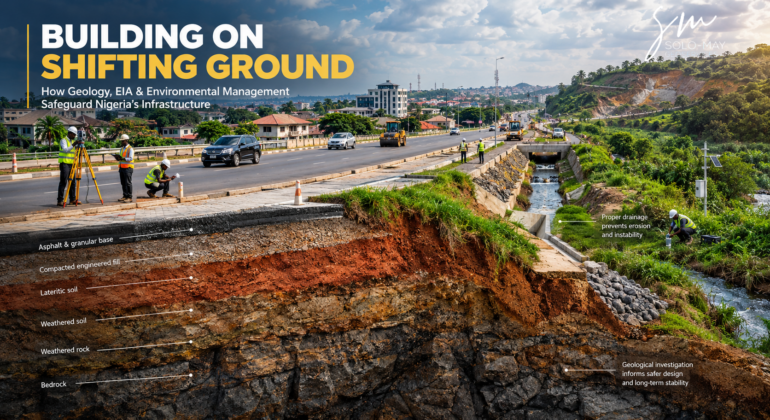

Nigeria’s expanding infrastructure sector presents opportunities for housing, transport, commercial development and industrial growth. But every successful project depends on more than its design, construction budget and delivery schedule. It also depends on understanding the ground beneath the site, assessing potential environmental impacts and managing risks throughout the project’s life cycle.
From erosion-prone landscapes in southeastern Nigeria to waterlogged coastal terrain in Lagos and the Niger Delta, site conditions can influence construction stability, drainage, erosion control and long-term maintenance.
For developers, contractors, investors and project managers, three areas deserve early attention: geological investigation, Environmental Impact Assessment (EIA), and ongoing environmental management.
1. The Geological Reality: Nigeria’s Natural Risk Zone

Every infrastructure project begins with the ground beneath it, but Nigeria’s geology is far from uniform. Without serious geological hazard assessments, engineering feats quickly turn into structural disasters. Punch Newspapers
- The Gully Crises of the Southeast: In states like Anambra, Abia, and Enugu, the soil is composed heavily of loosely consolidated coastal plain sands (Nanka Sands). Coupled with intense tropical rainfall and poor drainage planning, natural runoffs rapidly transition into aggressive gully erosion. This is heavily documented in the ResearchGate Study on NEWMAP Gully Erosion Interventions, which highlights how entire communities and multi-million Naira roads are regularly swallowed by gully-induced landslides.
- Coastal Subsidence in the South-West: Across Lagos and the coastal Niger Delta, developers face high water tables, coastal erosion, and soft organic soils. For business people investing billions into real estate, ignoring soil mechanics and subsidence profiles can result in sinking foundations and chronic structural fracturing. In coastal areas such as Lagos, high groundwater levels and soft ground conditions can present foundation and settlement challenges. Appropriate geotechnical investigation helps engineers assess site conditions and select suitable foundation designs. LASBCA
- Mining Scars in the North-Central Region: Decades of structured and illegal artisanal mining have left areas like Jos and parts of Abuja structurally vulnerable. Abandoned open pits and underground voids create artificial sinkholes and land instability, requiring specialized subsurface remediation before safe building can occur. Policy and Legal Advocacy Centre
2. The Regulatory Shield: Navigating the EIA Process in Nigeria
How do we prevent these geological hazards from destroying our investments? This is where the legal and technical framework of the Environmental Impact Assessment (EIA) Act Cap E12 comes into play.
An EIA is not merely a bureaucratic stall tactic; it is a predictive data-gathering exercise that outlines how a project will affect and be affected by its immediate environment. The law mandates a clear multi-step process before any major Category I or II project can legally begin: NESREA
| 1. Screening | Determining if the scale of your project (e.g., a power plant, major estate, or road network) requires a full, partial, or no EIA. |
| 2. Scoping | Identifying the specific environmental, geological, and social issues that need the deepest study. |
| 3. Baseline Studies | Deploying scientists and engineers to test soil stability, water quality, and local biodiversity before any concrete is poured. |
| 4. Impact Mitigation & Reporting | Creating an Environmental Management Plan (EMP) that proves how your project will handle risks like runoff redirection or waste discharge. NESREA |
| 5. Review and Certification: | Presenting the findings for public review and regulatory panels to secure the official EIA Certificate issued by the Federal Ministry of Environment. Ead.gov.ng |
3. Beyond Approval: Active Environmental Management
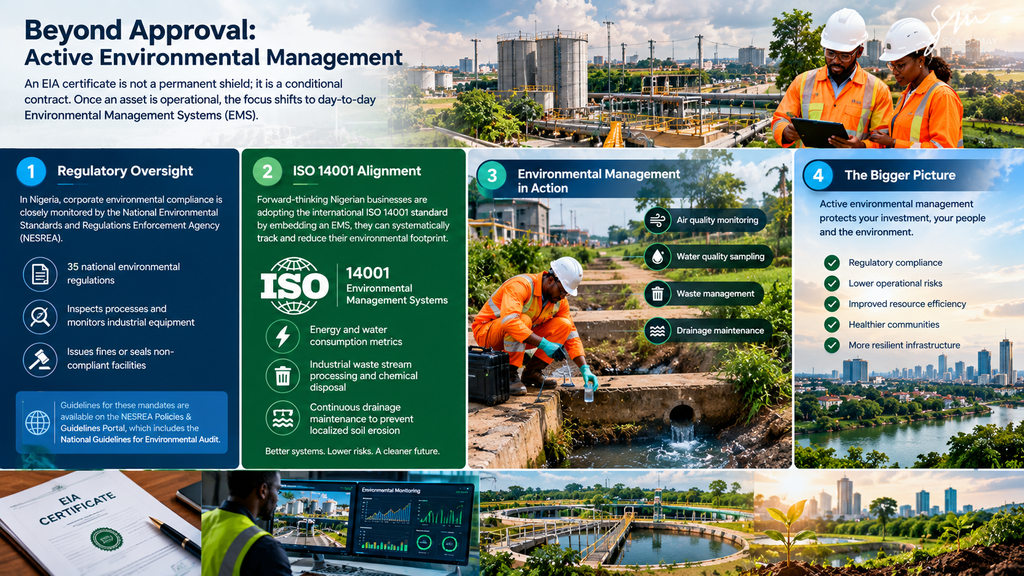
An EIA certificate is not a permanent shield; it is a conditional contract. Once an asset is operational, the focus shifts to day-to-day Environmental Management Systems (EMS).
In Nigeria, corporate environmental compliance is closely monitored by the National Environmental Standards and Regulations Enforcement Agency (NESREA). NESREA’s 35 national regulations give them the authority to inspect processes, monitor industrial equipment, and issue hefty fines or seal up non-compliant facilities. The functional guidelines for these mandates are actively tracked via the NESREA Policies & Guidelines Portal, which includes the National Guidelines for Environmental Audit.
Forward-thinking Nigerian corporate entities are looking past basic domestic policing and actively aligning with the international ISO 14001 standard. By embedding an ISO-aligned EMS, businesses can systematically track operational resource footprints:
- Energy and water consumption metrics.
- Industrial waste stream processing and chemical disposal.
- Continuous drainage maintenance to prevent localized soil erosion.
Conclusion: Build with evidence, not assumptions
Nigeria’s future relies on sophisticated building practices. Corporate executives must realize that integrating geological engineering, strict EIA timelines, and robust environmental management systems isn’t just about regulatory compliance, it protects financial profit, guards human lives, and preserves our natural environment. True business leaders build to last, ensuring their physical legacies stand firm on solid ground. NESREA
Planning a construction, industrial or infrastructure project? Solo-May Geoservices supports environmental assessment, environmental monitoring and compliance-related activities. Contact us to discuss the requirements relevant to your project and site.
Frequently Asked Questions (FAQs)
A: No. The EIA Act strictly prohibits the commencement of projects on the mandatory study list without prior approval and certification. According to established protocols detailed by Solo-May Geoservices Guide, jumping the gun risks immediate project shutdowns, asset closures, and heavy legal penalties.
A: The Federal Ministry of Environment (via the Environmental Assessment Department) is responsible for reviewing, processing, and issuing EIA Certificates before a project commences. NESREA, on the other hand, is the enforcement arm that ensures facilities maintain those set environmental standards and conducts ongoing environmental audits after the project is active.
A: The regulatory timeline can range from 6 to 12 months depending on the project category. This accounts for gathering baseline biological data across opposite seasons (wet and dry season fields), the statutory 21-day public display period for stakeholder feedback, and the technical panel evaluations.
A: An EIA certificate is issued for the life cycle of the approved project design. However, if a developer secures a certificate but fails to break ground or commence physical development within 3 years of issuance, the certificate lapses and requires a regulatory re-validation. NESREA
A: Not always a full assessment. The Federal Ministry of Environment breaks projects into three categories based on scale and potential damage. Major infrastructures (dams, large-scale mining, oil pipelines) are Category 1 and require a full EIA. Smaller businesses often fall under Category 2 or 3, which may only require an Initial Environmental Evaluation (IEE), minimizing approval times
A: Under NESREA’s active regulations, corporate violators face stiff administrative fines ranging from ₦1,000,000 to ₦5,000,000 for non-compliance, alongside continuous daily fines for delayed remediation, facility closure, and criminal liability for negligent company director.